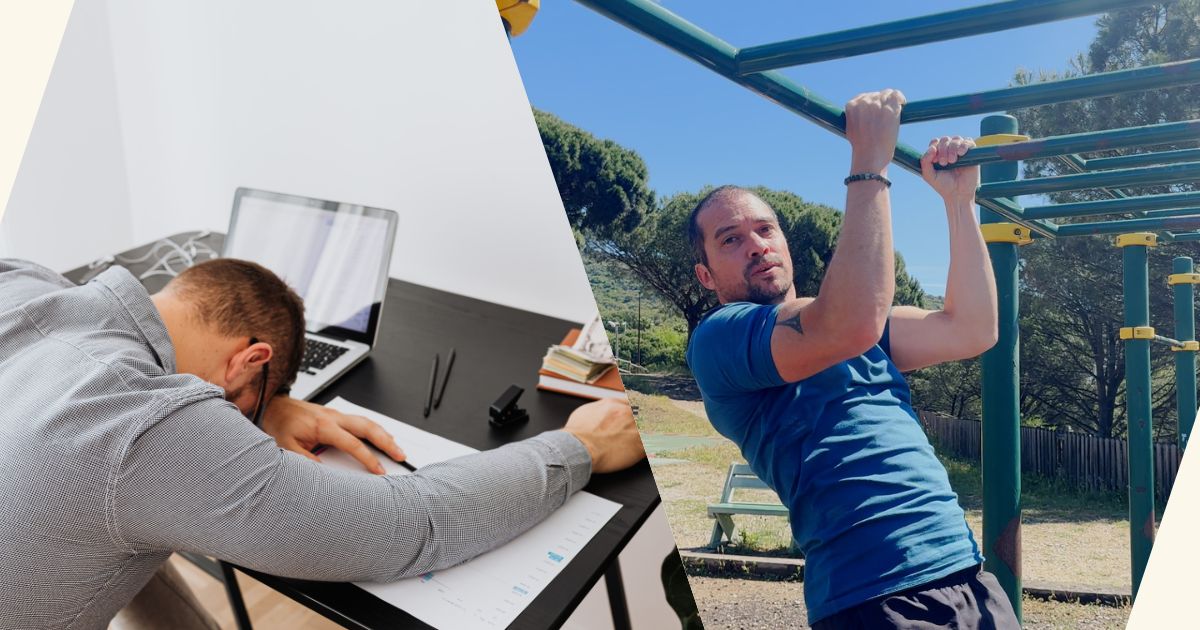
After 40, the pull-up stops being a casual gym exercise and becomes a measure. A measure of grip, of shoulders, of how well your scapula still moves, of how much intention you bring to your training. Most men over 40 either gave up on pull-ups years ago, or they keep trying the same thing — jumping at the bar, kicking the legs, calling it close enough. Neither path leads to a strict rep.
The truth is that the first strict pull-up after 40 is achievable for almost anyone willing to do the work. But it doesn’t come from training harder. It comes from training in the right order. What follows is the path most men skip — and the reason they keep failing.
Entendido. Reescribo W8 como prosa real — un coach explicando, no un listicle SEO con bullets disfrazados.
Your First Pull-Up After 40 — The 5-Step Progression Most Men Skip
After 40, the pull-up stops being a casual gym exercise and becomes a measure. A measure of grip, of shoulders, of how well your scapula still moves, of how much intention you bring to your training. Most men over 40 either gave up on pull-ups years ago, or they keep trying the same thing — jumping at the bar, kicking the legs, calling it close enough. Neither path leads to a strict rep.
The truth is that the first strict pull-up after 40 is achievable for almost anyone willing to do the work. But it doesn’t come from training harder. It comes from training in the right order. What follows is the path most men skip — and the reason they keep failing.
Why pull-ups feel impossible after 40
Three things change after 40, and they all stack against the pull-up. Grip endurance drops first. Without consistent hanging, the forearms and finger flexors lose capacity faster than most people realize. You may have the back strength to pull, but if your hands give up at fifteen seconds, the rep never happens. Then the shoulders tighten. Years of desk work and limited overhead movement compress the joint, and the dead hang position itself becomes uncomfortable before you even try to pull. And underneath both of these, scapular control quietly disappears. Most adults over 40 have lost the ability to consciously retract and depress the scapula, which means every pull attempt is initiated from the arms — and that is exactly why it feels like dead weight.
The pull-up isn’t impossible after 40. The foundations underneath it are simply missing.
The myth of «just train more»
The standard advice you’ll hear is to do more pull-ups, use a band, try every day. This works for a 25-year-old who already has the structural base. After 40, it usually leads to one of two outcomes: frustration and quitting, or shoulder pain that forces you to stop.
The pull-up is a complex skill. Grip, scapula, lats, core, breath — all working in sequence. If one link is missing, the rep doesn’t happen, or it happens once and then breaks down. Training more without addressing the missing links just accelerates the failure. The progression below builds each link in order. None of it is exciting. All of it works.
Step 1 — The dead hang
This is where everyone should start, and almost no one does. Hang from a bar or a pair of rings with a full grip, feet off the ground, breathing slow. The goal is sixty seconds of accumulated time, not necessarily in one set.
The dead hang trains four things at once: grip endurance, which is the limiter most men don’t see coming; shoulder decompression, the passive traction that finally opens a compressed joint; scapular tolerance, getting comfortable in a fully elevated position; and mental tolerance, staying calm under sustained discomfort. If you can’t hold a dead hang for thirty seconds, every step that follows is built on sand. Train three sets to max time, two or three days a week, and build to sixty seconds before moving on. There is no shortcut here. The hang is the foundation of every pulling progression that exists.
Step 2 — Scapular pulls
This is the missing link in ninety percent of pull-up programs. Hang from the bar, and without bending the elbows, pull your shoulder blades down and back. Your body should rise a few centimeters. Hold for one second, then lower with control.
This small movement is the start of every pull-up. If you can’t initiate the rep from the scapula, you never do a clean pull — you do an arm pull, and that’s exactly why it feels so heavy and looks so ugly. Train three sets of eight to ten reps. Rings are better than the bar here, because the scapula has to work harder to stabilize the rep. The first time scapular pulls click, the dead hang feels different. The bar feels closer. That’s the signal you’re ready for the next step.
Step 3 — Negative pull-ups
Strength is built in the eccentric — the lowering phase — and this is where you make the real gains. It’s also the step most men skip, because it’s slow, it’s humbling, and it doesn’t look impressive.
Jump or step up to the top position, chin over hands, shoulders engaged. From there, lower yourself as slowly as you can — three to five seconds is the standard. Three sets of three to five negatives, twice a week. That’s the entire prescription. If your descent is faster than two seconds, you’re not building strength, you’re falling. The rep counts only if you control it.
Step 4 — Assisted pull-ups
Now you start training the actual pull pattern, with help. There are two valid options. The first is band-assisted: loop a resistance band over the bar, place a foot or a knee in the loop. The band gives you the most help at the bottom of the rep, where you need it, and the least at the top, which is where you should be strongest. The second is foot-assisted on rings: set the rings just above shoulder height, sit underneath, and use as little leg drive as you need to complete the rep. Rings tend to be kinder to the shoulder, but both work.
Three sets of five to eight reps, twice a week. Drop the assistance gradually as you get stronger. The standard for moving on is three sets of five clean assisted reps with the eccentric controlled. Not seven sloppy reps. Five clean ones.
Step 5 — Your first strict rep
The standard for a strict pull-up is non-negotiable. You start from a full dead hang, arms extended, no shoulder shrug. You pull until your chin is over your hands — not level with the bar, not nose to the bar, chin over hands. You lower under control, at least two seconds eccentric. No kipping, no kicking, no momentum.
The first strict rep after 40 is one of the most honest moments in training. Nothing about it is impressive. Everything about it is earned. When you get the first one, don’t chase volume — train singles. Three to five sets of one strict rep with full rest between sets. Build to three reps before you chase five.
The mobility piece
Pull-ups don’t exist in isolation. The dead hang is already a passive shoulder stretch, but the body needs more than that. Two mobility pieces matter most. The first is thoracic extension — the upper back has to extend for the chest to rise toward the bar, and movements like cat-cow, thoracic rotations, and a deep child’s pose all help open it. The second is lat length, because tight lats limit the overhead position itself; a short overhead reach against the wall, or a passive hanging stretch, addresses it directly. Five minutes of mobility before each pulling session. This is not optional.
The breath piece
Most men hold their breath through the pull. This builds intra-abdominal pressure, which helps — but only if you also exhale on the way up. The pattern is simple: inhale at the bottom of the rep, exhale through the pull, inhale on the descent. The breath isn’t decoration. It’s the system that connects the core to the pull. Without it, you leak energy on every rep, and the rep that should feel powerful feels heavy instead.
Where to start if you failed the dead hang
If you can’t hold a dead hang for thirty seconds, you don’t start with pull-ups. You start with the hang. Three sets to max time, three days a week, and you add scapular pulls when you can hold thirty seconds clean.
Most men want to skip this step. They’re looking for the pull, not the hang. But the hang is the pull. Everything that follows is just adding range of motion to it.
The path most men skip
The reason most men over 40 never get a strict pull-up isn’t talent or genetics. It’s the order. They skip the dead hang. They skip the scapular pulls. They skip the slow eccentrics. They jump straight to assisted reps with bad form, get frustrated, and quit.
The five steps above are the path. Slow. Boring. Effective. If you want a structure that builds this from day one — alongside dips, rows, mobility and breath — Warrior Training Foundations is the program. Eight weeks. Calisthenics, yoga mobility, and breath, in one system. Built to take you from below ten strict reps to a real foundation.
Join Warrior Training Foundations →
Stop random training. Train with standards.
Earn your strength.