Most men over 30 can’t hang from a bar for sixty seconds. That’s a problem — but it’s only the beginning of the problem. The dead hang is the first test of upper body integrity, but it isn’t the only one. To build a real foundation for pull-ups, dips, muscle-ups and anything heavier that comes after, the 3 hangs every man over 30 should train weekly are dead hang, active hang, and pull hold.
Most lifters skip two of them. They train the dead hang occasionally, ignore the active hang completely, and never even attempt the pull hold. That’s exactly why their pull-ups feel heavy, their shoulders feel locked, and their progress stalls. This article is the protocol — what each hang reveals, the standard for each, and the weekly prescription that builds the foundation underneath every pulling movement.
Why Hangs Are the Foundation
Before pull-ups, before muscle-ups, before adding any weight to your body, you need to be able to hang. Not casually. Not for ten seconds with kicking legs. Hang in the way the shoulder joint is meant to load — passively, actively, and under tension at the top of a pull.
After 30, three things start working against you. Grip endurance drops as the forearms and finger flexors lose capacity from years of disuse. Shoulder mobility tightens from desk work and limited overhead movement, compressing the joint. And scapular control disappears, because most adults have lost the ability to consciously move the shoulder blades through their full range. Each of the 3 hangs trains one of these directly. Skip them, and every pulling progression you attempt is built on a missing foundation.
Hang #1 — The Dead Hang
The dead hang is passive. You hang from a bar or a pair of rings with a full grip, arms fully extended, shoulders relaxed and elevated, body completely loose. Nothing is engaged. Gravity does the work.
This is the test of grip endurance and passive shoulder decompression. It tells you whether your hands and forearms can sustain your bodyweight, and whether your shoulder joint can tolerate being loaded passively at full extension. Most men fail at thirty seconds, and the failure is almost always the grip — not the shoulder. The fix is exposure: hanging consistently, multiple times per week, until the tissue adapts.
The standard is sixty seconds. Beginners start around thirty. A solid foundation is sixty. Anything beyond ninety seconds is advanced. Train three sets to max time, two or three sessions per week, and treat the dead hang as the non-negotiable base of your program.
Hang #2 — The Active Hang
The active hang is where most lifters discover they don’t actually have shoulders. From a dead hang position, without bending the elbows, you pull your shoulder blades down and back. The body rises a few centimeters. The shoulders engage. The lats activate. The position is now stable and ready to pull.
This is the test of scapular control. It is also the missing link in ninety percent of pull-up programs. If you can’t hold an active hang, you can’t initiate a pull from the scapula — which means every pull-up you attempt starts from the arms, and that’s why it feels so heavy and looks so ugly. The active hang trains the exact moment that should begin every pulling rep.
The standard is thirty seconds held cleanly, with the scapula fully engaged and the body stable. Train two sets to max time, on the same days as your dead hang work. Most men find the active hang dramatically harder than the dead hang the first time they try it. That’s information — it tells you exactly where the gap is.
Hang #3 — The Pull Hold
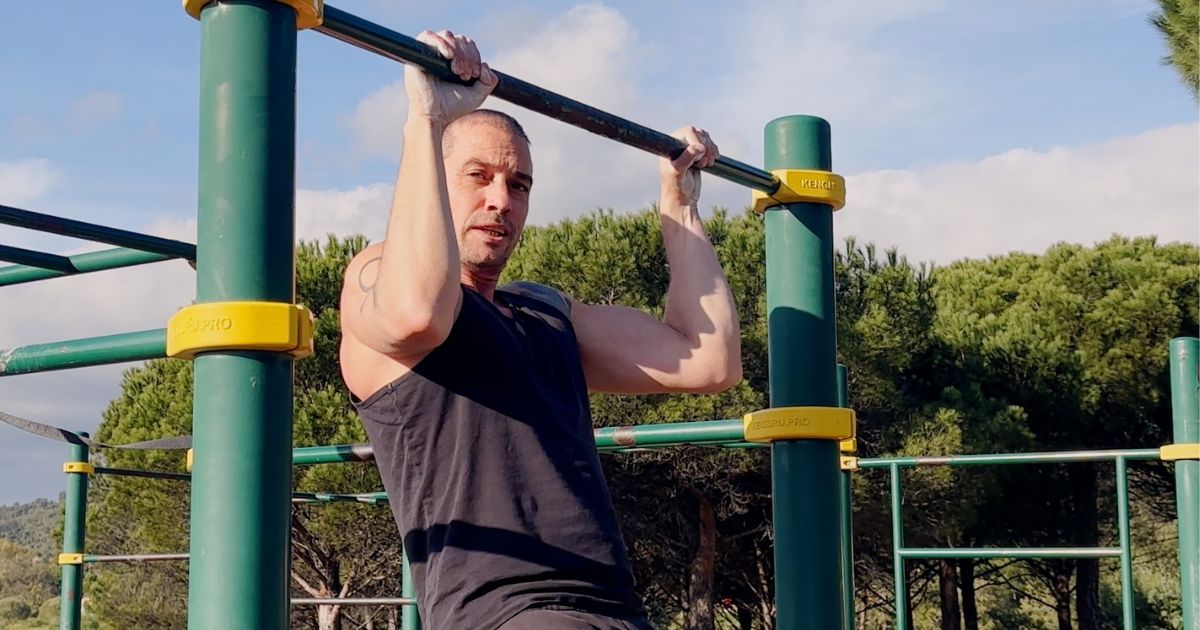
The pull hold is the top of a pull-up — chin over hands, elbows bent, shoulders engaged, body still. You either jump up to the position or step up from a box, then hold for as long as you can.
This is the test of top-position strength, and the gateway to your first strict pull-up. Most men can pull themselves up once with momentum but can’t hold the top position for five seconds. That tells you the pull was a phase pass, not a controlled rep. The pull hold builds the strength that makes the top of every pull-up real, and it’s where the bicep, lat and grip all integrate under load.
The standard is fifteen seconds for a beginner, thirty seconds for a solid foundation. Train two sets to max time, twice per week, after your dead hang and active hang work. The pull hold is the bridge between hanging and pulling. Without it, the first strict rep stays out of reach.
The Weekly Protocol
The full prescription for the 3 hangs every man over 30 should train weekly looks like this:
Dead hang — three sets to max time. Active hang — two sets to max time. Pull hold — two sets to max time. Total of seven sets across the three hangs, two or three sessions per week, with full rest between each set.
Order matters. Always start with the dead hang, because it warms up the grip and the shoulder joint passively. Move to the active hang second, while the shoulders are loaded but the muscles are still fresh. Finish with the pull hold, when grip and scapula are both prepared. Reversing the order doesn’t kill the workout, but doing the pull hold first will compromise everything that follows.
Rest at least one full minute between sets, longer if needed. These are not endurance circuits. They are tests of structural integrity, and quality matters more than density.
Standards by Age
The standards adjust with age, but the 3 hangs remain the same protocol. In your 30s, the targets are sixty seconds dead hang, thirty seconds active hang, thirty seconds pull hold. In your 40s, the targets are forty-five seconds dead hang, twenty seconds active hang, twenty seconds pull hold. In your 50s, the targets are thirty seconds dead hang, fifteen seconds active hang, fifteen seconds pull hold.
These are real-world benchmarks for a strong, mobile, capable man — not elite athlete numbers. If you’re below the standard for your age, you have a clear starting point. If you’re above it, you have a clear progression: add weight, add range, or move to harder variations like one-arm dead hangs and weighted pull holds.
Common Failures and What They Mean
If you fail at the dead hang before thirty seconds, the limiter is grip. Train daily exposures of short hangs throughout the week. The forearms recover quickly and respond to frequency more than intensity.
If you fail at the active hang within ten seconds, the limiter is scapular control. Your shoulder blades have lost the ability to retract and depress under load. Add scapular pulls — three sets of eight to ten reps, twice per week — alongside your active hang work.
If you fail at the pull hold within five seconds, the limiter is top-position strength. Add isometric pulls and partial-range pull-ups, working the top half of the movement specifically, two or three times per week.
The 3 hangs are diagnostic as well as developmental. Each failure points to a specific gap, and each gap has a specific fix.
Why This Is the Foundation
The 3 hangs are not a warm-up. They are not an accessory. They are the structural test of whether your upper body can hold itself together under load. Train them weekly and the rest of your calisthenics work — pull-ups, dips, rows, muscle-ups — has a base to grow from. Skip them and every progression you chase will plateau.
After 30, after 40, after 50, the body needs a system that respects how it actually works. The 3 hangs are that system. Slow. Honest. Effective.
Ready to build the foundation underneath every pull?
Warrior Training Foundations is built around exactly this kind of work — the hangs, the standards, the slow honest progressions that most men skip. Eight weeks. Calisthenics, mobility, breath. One integrated system.
👉 Join Warrior Training Foundations →
Stop random training. Train with standards.
Earn your strength.