
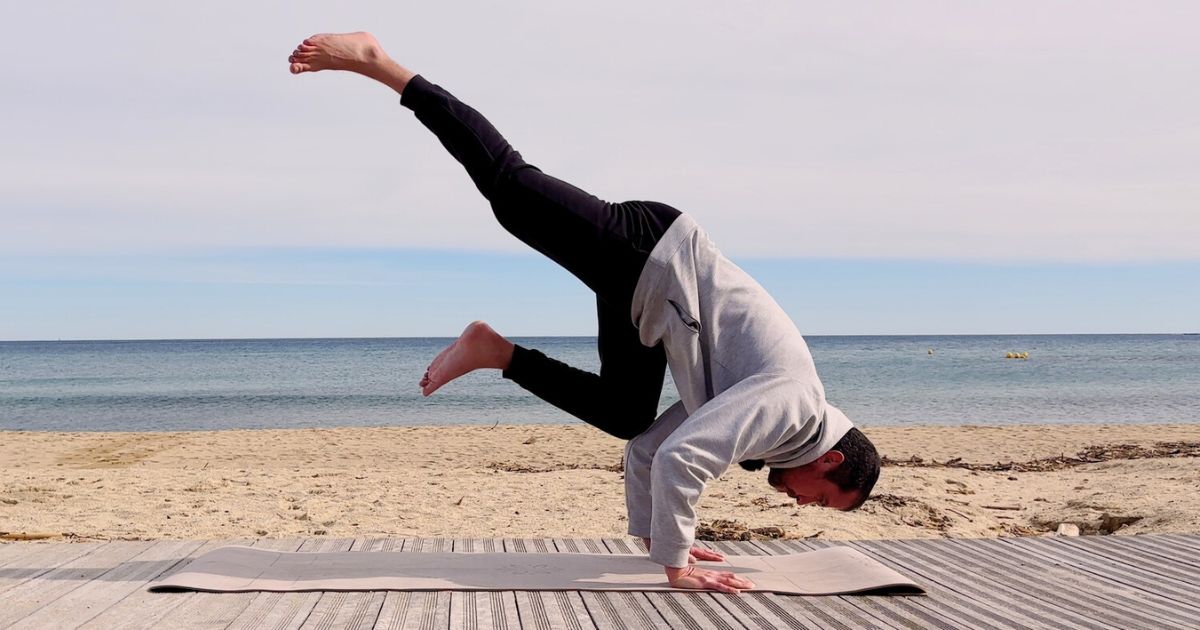
Flying Crow is not an advanced trick. It is a progression earned through structure. Before attempting Eka Pada Bakasana, you must first build a stable and controlled Bakasana. Without that base, the transition becomes unstable and inefficient.
Bakasana requires more than balance. It demands shoulder stability, active scapular protraction, deep abdominal compression and total body tension. If you cannot hold Bakasana for at least 20 to 30 seconds with calm breathing, you are not ready to level up.
The first phase of progression is time under tension. Accumulate clean holds. Focus on pushing the floor away, rounding through the upper back and maintaining active core engagement. The quality of this hold determines the safety of the next step.
Once control is established, you can begin exploring transitions. Practice entering Bakasana with control, stepping or lightly floating in. Learn to exit without collapsing. Straight-arm variations and Lolasana or tucked planche strengthen the compression required for Flying Crow.
To support this progression, integrate focused strength work. A simple structure works well: 3×10 Navasana to Hollow transitions, 3×10 Chaturanga push-ups, and 3×5 Pike push-ups. After strength work, alternate controlled attempts in Eka Pada Bakasana.
Flying Crow is not about ego. It is about disciplined progression. Master the base, build the structure, and the advanced posture becomes a natural extension of your practice.
Related Articles
Stay Connected
Follow us on Instagram

Continue Reading: Full Body Calisthenics Routine for Beginners (4 Exercises)