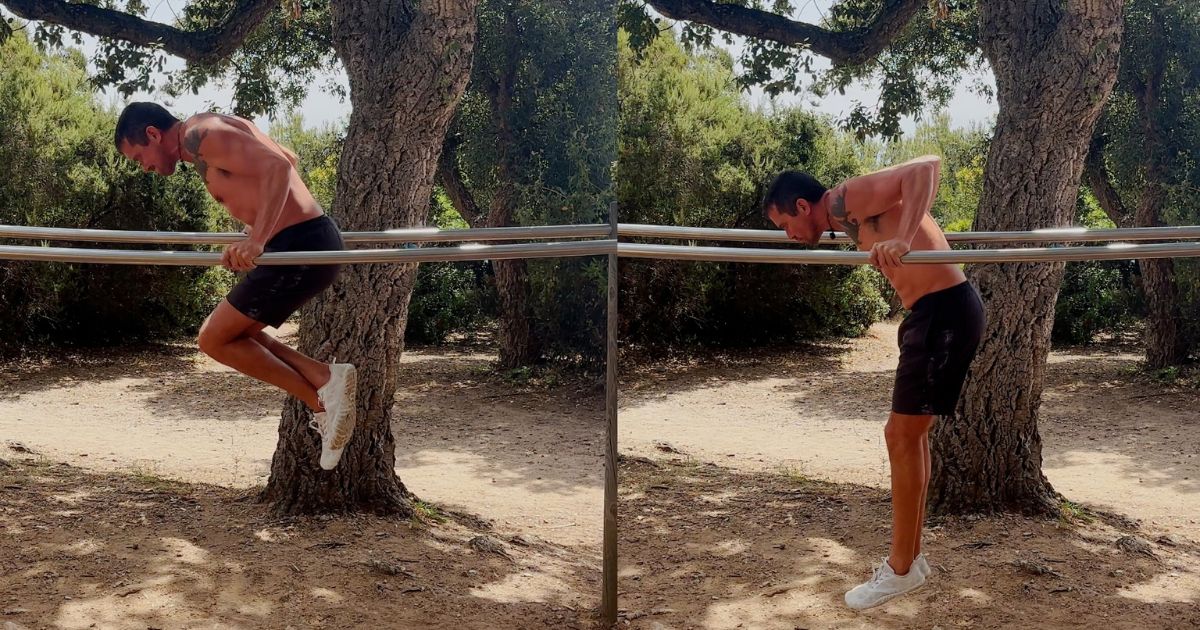
A strict dip looks simple from the outside: arms bend, body lowers, arms push back up. But most men who attempt it are doing a shortened, compensated version without realizing it. The dip is one of the two foundational pushing movements for upper body strength — alongside the push-up — and it tests shoulder control, chest depth, and tricep stability all at once.
If your dips look messy, the issue is rarely strength alone. It’s usually one of three things.
The three most common mistakes
1. Cutting the range of motion. Short reps let you avoid the hardest part of the movement — the bottom range, where the shoulders and chest are under the most load.
2. Flaring the elbows out. When the elbows drift sideways instead of staying close to the body, the shoulders take on stress they’re not equipped to handle in that position.
3. Poor leg position and a disengaged core. Crossed or loose legs and a relaxed midsection turn the dip into an unstable, swinging movement instead of a controlled one.
How to execute the strict dip correctly
Start with your shoulders protracted — actively pushing through the scapulas rather than letting them sink. Bring your feet together, pointing slightly forward, and keep your core activated throughout.
From this position, lower slowly until you reach the full range your current mobility allows, then push back up to a complete lockout of the elbows. Repeat with control, not momentum.
A variation for muscle-up preparation: the front dip
If you want to add variation and begin preparing for the muscle-up, the front dip is a useful progression. Use the same neutral grip you’d use for pull-ups. Starting from the top position with shoulders protracted, lower all the way down until your chest touches the bar, then push back up to full lockout. This trains the same pressing pattern you’ll need to finish a muscle-up.
If you’re not ready for parallel bars yet
Bench dips are the natural entry point. Work on a bench, bending your knees if needed to manage the load, and keep the same rule that applies everywhere else: don’t let the elbows flare out — they stay pointing backward.
The benchmark before progressing
Once you can perform around 20 controlled bench dip reps and 20 full push-ups without your knees on the floor, you’re ready to begin training strict dips on parallel bars.
Why this matters beyond the movement
The strict dip isn’t just a strength exercise — it’s a diagnostic. It reveals where your shoulders lack stability, where your range of motion is limited, and whether you can stay controlled under effort instead of relying on momentum. Training it properly builds the physical foundation, while the discipline required to do it slowly and correctly — rep after rep — builds something beyond the body.
If you’re ready to start a structured path that combines calisthenics, mobility, and the mental discipline to sustain it, Warrior Training Foundations gives you the exact program to build that foundation.